Managed transportation services are one of the most practical tools available to a growing shipper, and one of the least talked about. If your team spends more time managing freight than running your core business, or your freight costs keep rising without a clear explanation, this is worth understanding.
Here is what managed transportation is, what it includes, and how to know if it makes sense for your operation right now.

Managed transportation in plain English
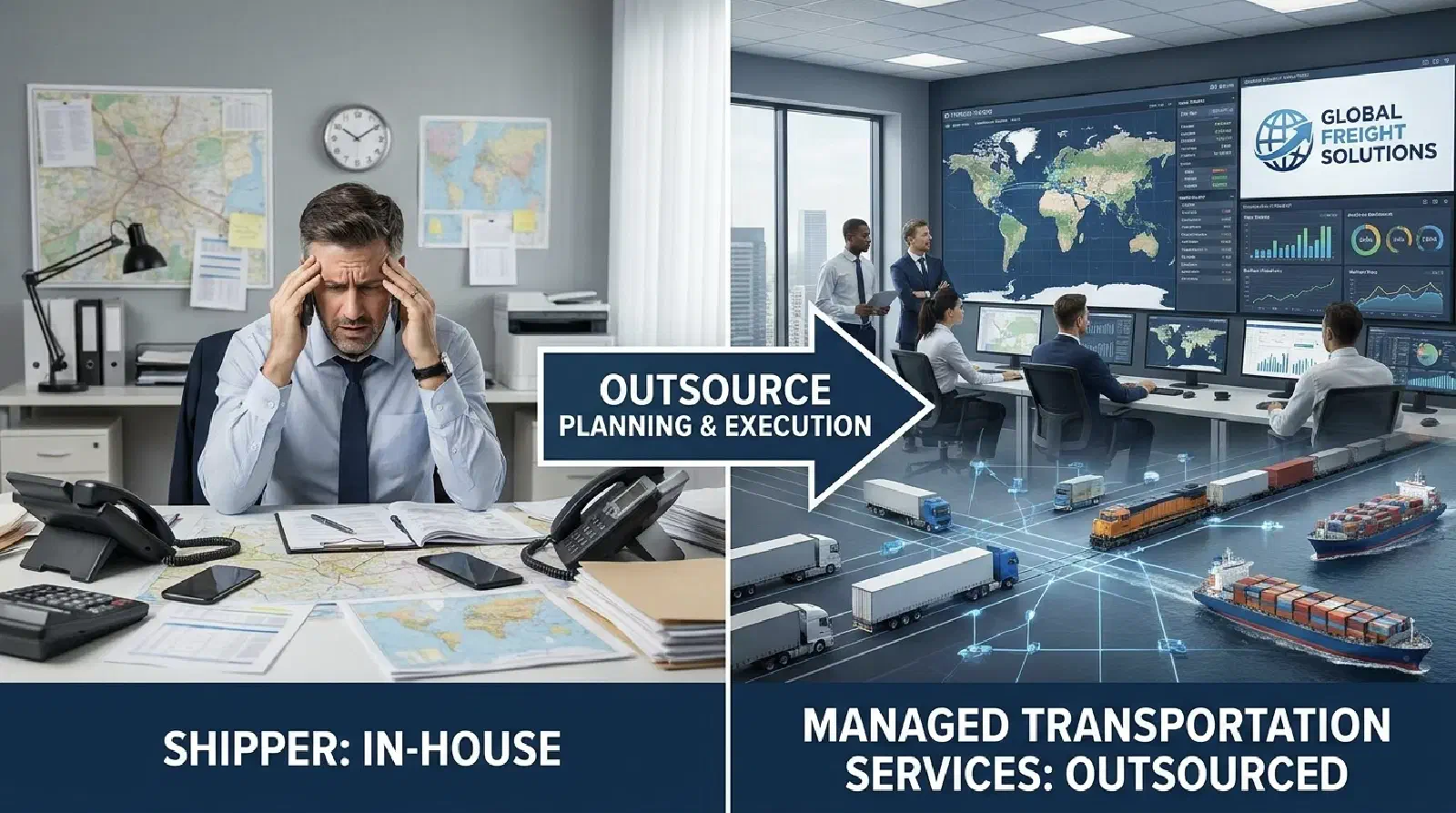
Managed transportation services is an outsourced freight model where a third-party provider takes operational accountability for a shipper’s freight program, including carrier procurement, tendering, tracking, invoice auditing, and reporting.
The simplest way to think about it is this: instead of one or two people internally trying to manage carriers, book loads, chase down shipment updates, and audit invoices, you hand that function to a freight partner that does it every day, at scale, with better technology and deeper carrier relationships than most companies can build on their own.
You keep control of your freight strategy. The managed transportation provider handles execution.
What a managed transportation provider actually does
Carrier procurement and management
A managed transportation provider builds and maintains your carrier relationships on your behalf. Providers can often negotiate better rates than a shipper can achieve independently, and they bring visibility into multiple supply chains that helps surface best practices and savings opportunities.
That buying power is something many small and mid-sized shippers simply cannot replicate on their own.
Shipment execution and visibility
Load tendering, dispatch, exception handling, and real-time tracking all sit with the provider. Think of managed transportation as having your own control tower. You can see your on-time delivery performance and get real-time visibility into your shipments, while a dedicated team handles carrier selection, rate negotiation, tracking, reporting, and day-to-day issue resolution.
When a load is rejected or a shipment runs late, the provider resolves it instead of your internal team absorbing the disruption.
Freight auditing and reporting
Billing errors are common in freight, and they add up quickly. A managed transportation provider handles freight auditing as part of the service, verifying that invoices match contracted rates and approved accessorials before you pay them.
You get consolidated reporting and cleaner transportation data instead of a stack of invoices from multiple carriers to sort through manually.
Managed transportation vs. freight brokerage
This is the question that comes up most often, and the distinction matters.
A freight broker helps cover individual shipments. The relationship is often transactional. You call when you have a load, they find a carrier, and the transaction ends there.
Managed transportation is different because the accountability is different. A broker is accountable for covering the load. A managed transportation provider is accountable for freight program outcomes including cost, service, and data quality.
Managed transportation can also consolidate what is often a fragmented mix of broker relationships into one accountable program. Rather than managing multiple broker contacts, routing guides, and invoice formats, everything runs through a single partner with a unified view of your freight.
If you are currently working with several different brokers and have no consistent visibility across all of them, that fragmentation itself may be a cost worth addressing.

Who is it right for?
Not every shipper needs managed transportation services, but more do than most realize.
The best fit is usually a company that ships regularly across multiple lanes or modes, is growing faster than its internal logistics capacity can keep up with, or is relying on a small team to manage freight alongside many other responsibilities.
One useful indicator is broker count. Companies managing freight through five or more brokers without a unified view often benefit from outsourcing because the fragmentation creates extra cost, extra communication, and extra room for mistakes.
If your LTL, full truckload, and intermodal freight is being managed across different relationships with no single point of accountability, managed transportation is worth a serious look.
What to look for in a provider
When evaluating managed transportation services, the technology matters but the people matter more. Ask the provider how they handle exceptions, how they communicate when something goes wrong, and what their carrier vetting process looks like.
The provider should be able to grow with you rather than forcing you to add internal headcount every time your shipping volume increases.
Also ask about service scope. A provider that can manage LTL, temperature-controlled freight, drayage, and parcel through one relationship gives you stronger visibility and leverage than managing each mode separately.
Final takeaway
Managed transportation services give growing shippers access to the carrier relationships, technology, and logistics expertise that many companies cannot build cost-effectively on their own. If your freight program feels reactive, expensive, or understaffed, it may be the right time to understand what outsourcing that function actually looks like in practice.
At HighQ Logistics, our managed transportation service is built for small and mid-sized shippers that need real logistics support without building an entire department to get it. If you want to talk through your current freight setup and whether managed transportation makes sense for you, contact the HighQ team or start with a freight quote request.